Actions
Attacking, remaining in place, casting a spell, giving an item and using an item all count as actions. You may only move before taking an action, and only one action can be taken each turn. Changing your equipped items or dropping an item do not count as an action.
Roll to Hit
If you’re in weapon range of an enemy, you may attempt a melee attack. This is represented by rolling a d100, where if you fall in your target's evade rate it's a miss, if you beat it, it's a hit and if you meet your critical rate with a high enough roll it’s a critical hit.
Roll for Damage Variance
If it's not a miss, roll for you damage variance. You'll roll either one or two dice, dependent on your weapon skill level and the weapon being wielded.
Damage Variance
Skill Level
Dice Rolled
Weapon Type
Dice Rolled
Level 0
+1d2
Mithril
+1d2
Level 1
+1d4
Unique/Cursed
+1d4
Level 2
+1d6
Orichalcum
+1d6
Level 3
+1d8
Hero Final
+1d8
Roll for Counter Attack
Finally, check for a counter attack chance. This is represented by rolling a d100, where if you fall in your target's counter rate, they'll strike at you as you do to them. Should they counter, roll for their own damage variance.
Critical Hits
A critical hit deals extra damage based on the proficiency level of the critical being unleashed.
Notes on Actions
There are no double attacks in this system. Critical hits cannot be countered. Counter attacks cannot critical. A character cannot evade and attack and then counter attack. Spells cannot inflict critical hits.
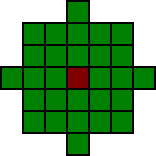
Range 3 attacks work slightly differently in this system. This diagram displays how it functions. The red square denotes where the character is attacking or casting from. Any tile that is a green square may be targetted (unless of course they are a ranged only unit, and therefore cannot attack units that are next to them).
Items
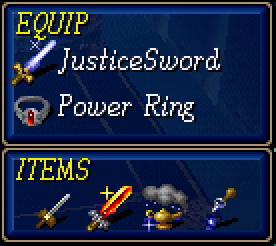
Each character may hold a maximum of 6 items. One of these slots is for an equipped weapon only, and another for an equipped accessory only. Force members may not attack unarmed.
Weapon, Accessory and Item Condition Chances
If a weapon, accessory or item can be used for an effect that isn't one time (one time being something like a medical herb), then there is a chance each time of it cracking.
On a d100 roll, a result of 1-30, the item will crack, and 31-100, the condition remains good. A cracked item that is then used will break irrepairably after outputting its effect one last time.
Levels and Promotion
Upon reaching 100 experience points (exp), their points reset to 0 (though any excess do carry over), and they move up a level, possibly gaining statistic gains in hit points, magic points, attack, defence and agility as they do so. In the first class tier, promotion becomes available at level 10 and the maximum level is level 20. In the second class tier, promotion becomes available at level 20.
Priest and Store Services
Priest: Curing poison (20 gold), releasing a curse (1/4 relevant item price), promotion (free), raising (50 gold per character level)
Store: selling an item to the store (1/2 list price), repairing an item (1/4 list price).
Statistics
The core statistics used are Hit Points (HP), Magic Points (MP), Attack, Defence, Agility, Luck, Movement Hit Points: If an individual's hit points are reduced to 0, they are defeated and if a Force member, must be raised. Once a battle has ended, if a character is still alive, all their hit points are restored. Magic Points: used to cast spells. Once it reaches 0 or below the least costing spell of that character, no more spell can be cast for the rest of the battle, unless MP is restored in some way. Once a battle has ended, all a character's magic points are restored. Attack: affects how much damage a character inflicts in melee combat. Defence: affects how much damage a character takes from melee combat. Agility: affects evade and counter rates. Movement: how far a character can move on the battlefield. Luck: affects evade, critical and counter rates, as well as chances of inflicting or succumbing status effects.
More Statistics Evade: (1 per 5 agility) + (1 per 10 agility) + (luck) %. For example, an agility of 10 and a luck of 7 would give an evade of 10% (3 agility + 7 luck) Critical: (1 per 5 character levels) + (3% per weapon special level) + (1% if you have a weapon bestowed special) + (luck) %. For example, A level 10 swordsman at second level specials in blades, with 5 luck and attacking with a blade would have a critical chance of 13% (2 character levels + 6 specials + 5 luck). Counter: (1 per 8 agility) + (1 per 12 agility) + (luck) %. For example, an agility of 24 and a luck of 7 would give an evade of 12% (5 agility + 7 luck).
Unlike with previous Shining Force games, a counter attack in this system occurs at full strength and happens simultaneously with the original attack. In this way, even if the character countering is defeated with the attack, they can still inflict damage as they go.
Agility Abilities
These rules were introduced to add value to the agility attribute, which has lost some of its value in a forum setting where the Force takes its turn as one, then the enemy follows. Whilst recommended, these are optional to use/include by the game's GM.
Evasion: +2 resistance bonus to each element per 20 points agility Evade & Counter: at 50 agility, the character gains the ability to dodge an enemy attack, as well as counter it. Blinding Speed: at 100 agility, once per battle, the character may take two actions in a single turn.
Status Effects
Charmed: the status inflicter controls the charmed target(s)
Confused: a d100 roll determines what action a confused character takes. 1-33 = Act as normal, 34-66 = Do nothing, 67-100 = Attack friend
Illusion: attacks are 50% less accurate
Paralysed: actions have only a 20% chance of being successfully carried out
Poison: individual loses a certain amount of hit points each turn after they take their action. The amount inflicted is determined by the poison's source, and so can vary.
Sleep: a character in unable to take any turns whilst asleep. They may resume taking actions the turn after they wake up.
Curse: has a certain effect as determined by the item causing. The effects can include paralysis, hp loss and mp loss.
Frozen: the character's feet are frozen and place and they may not move. This effect generally wears off after a single turn. Whilst frozen, the character's evade rate drops to 0.
Status effect chances
Generally, the chance of a status effect being inflicts is a percentage determined in a spell's description or in a monster's profile (created by the Game Master). Luck values do play a part here, especially if the caster has less luck than the target. For example, if Syntesis has 6 luck and casts Desoul (70% chance of working) against a target with 9 luck, the overall percent of success would drop by 10% for each difference in luck. Therefore, the usual 70% success rate of desoul would drop to 50%.